
Recent Highlights
Jul 2026
Talk Computing with reaction networks at input-independent speed at the 14th European Conference on Mathematical & Theoretical Biology (ECMTB), University of Graz, Austria. [Slides]
Jul 2026
Organizing Co-organized two minisymposia — Mathematical Foundations of Biochemical Computing and Molecular Computing: Theory and Implementations — at ECMTB 2026, Graz, with Jinsu Kim and Tung D. Nguyen.
May 2026
Keynote Invited keynote address at Chemical Reaction Networks in Hawaiʻi 2026 (CRNT2026), University of Hawaiʻi at Mānoa, Honolulu. Talk: Computing with reaction networks: input-independent speed and rate-constant-independent accuracy.
Mar 2026
Workshop Organized and participated in a Research in Teams workshop at the Banff International Research Station (BIRS): Mathematical foundations of chemical computing, Banff, Canada.
Sep 2025
Funding Awarded an AMS–Simons Research Enhancement Grant for PUI Faculty (September 2025 – August 2028).
Research
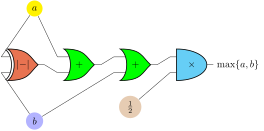
Chemical reaction network computing max(a,b)

Computing max(a,b) as a composition of elementary chemical reaction gates (Anderson & Joshi 2025).

Chemical Computation

Chemical reactions are a powerful computational substrate, raising the exciting prospect of implementing computation using biomolecules inside a living cell. We use mathematical theory of reaction networks and dynamical systems to develop algorithms that complement and guide breakthroughs in synthetic biology.

An analog computer based on reaction networks is naturally suited to simulating continuous processes such as differential equations. Arithmetic and transcendental functions are also essential, and implementing them reliably on an analog substrate comes with unique challenges — especially since analog computers interface directly with continuous, real-world signals. One challenge we identified: for generic algorithms, computation speed can depend not only on the operation but on the specific input values. A single slow step can become rate-limiting. We developed novel reaction network algorithms that achieve input-independent speed for all arithmetic operations and for exponential and logarithmic functions, giving robust and fast analog molecular computation.
[30][32][34][20]

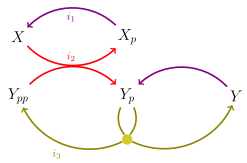
Substrate hypergraph with double edge encoding bifunctional enzyme

A substrate hypergraph (Joshi & Nguyen 2026) for a network with 3 composite reactions: Xp + YX + Yp, X + YppXp + Yp, 2YpYpp + Y

Substrate Hypergraphs & Robustness

The chemistry of life — biochemistry — has a unique structure that goes beyond ordinary chemistry. Biomolecules have special roles: substrates are the stars of the show, while enzymes direct the action. By focusing on substrates and codifying their interactions as a substrate hypergraph, we set aside the enzymes, intermediate compounds, and detailed internal reaction steps — not as a loss of information but as a gain in clarity, since major dynamical properties are agnostic to these hidden details, which may anyway be experimentally unknown. A graph-theoretic invariant we call hypergraph current turns out to be a key object: its structure governs existence, uniqueness, and stability of steady states, absolute concentration robustness, and bifurcation behavior — giving a unified dynamical portrait of the biochemical system from the hypergraph topology.
[31][33][29]

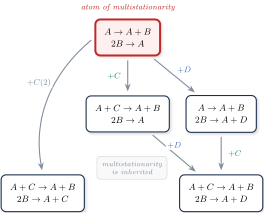
Hasse diagram of atoms of multistationarity

An atom of multistationarity and four descendants (Joshi & Shiu 2013).

Atoms of Multistationarity

The dynamics of a reaction network are difficult to characterize without knowing the reaction rate constants — and those constants aren’t truly constant, fluctuating with the environment in ways that are often unknown. Classical theory offers network conditions that rule out multistationarity, but not conditions that rule it in: the capacity to switch between distinct steady states, a behavior central to biological decision-making. We showed that multistationarity can be inherited: under well-defined conditions, a larger network acquires it from smaller networks embedded within. The smallest networks with this capacity we called atoms of multistationarity — the irreducible building blocks from which all multistationary behavior is assembled. Identifying new atoms and finding them operating inside real biochemical systems remains an active frontier.
[6][7][13][15][26][22]

Other research topics include:
static and dynamic absolute concentration robustness
[24][25][26][27] stochastic models of reaction networks
[12][17][23]

Teaching

MATH 448: Mathematical Models and Methods in Biology  —  Fall 2026  (course materials, interactive tools, homework)

Beyond Mathematics

In September 2025, I ran my first ever marathon — the Ladakh Marathon in Leh, Ladakh, India, at an elevation of 11,155 ft (3,401 m), where the air holds just 65% of the oxygen at sea level. The route passes through villages whose children line the course to high-five the runners; somehow that energy almost makes up for the altitude. Since then I have run three marathons on three continents, a half marathon, and the Big Sur 21-miler — where runners cross the iconic Bixby Creek Bridge to the sound of a grand piano played live at the cliff’s edge above the Pacific.

In October 2025, I completed a 14-day trek to Everest Base Camp — my first ever multiday hike. Heavy unseasonal snowfall in the opening days brought weather warnings and fears of being stranded; as it turned out, those same snows made the final push to Base Camp all the more dramatic and unforgettable.

Publications
  1. David F. Anderson and Badal Joshi (2026). Instantaneous arithmetic computation via ratio-encoding in chemical reaction networks. arXiv preprint.
    arXiv

  2. Badal Joshi, Tung D. Nguyen, and Matthew D. Johnston (2026). Bistability, Absolute Concentration Robustness, and Hysteresis in Dual-Site Futile Cycles with Bifunctional Enzymes. arXiv preprint.
    arXiv

  3. David F. Anderson, Badal Joshi, and Tung D. Nguyen (2026). Computing with reaction networks at input-independent speed: exponential and logarithmic functions. To appear in Natural Computing.
    arXiv

  4. Badal Joshi and Tung D. Nguyen (2026). Bifunctional enzyme action as a source of robustness in biochemical reaction networks: a novel hypergraph approach. Journal of the Royal Society Interface, Vol. 23, 20250252.
    doi arXiv

  5. David F. Anderson and Badal Joshi (2025). Chemical mass-action systems as analog computers: implementing arithmetic computations at specified speed. Theoretical Computer Science, Vol. 1025, 114983.
    doi arXiv

  6. Badal Joshi and Tung D. Nguyen (2024). Bifunctional enzyme provides absolute concentration robustness in multisite covalent modification networks. Journal of Mathematical Biology, Vol. 88, 36.
    doi arXiv

  7. Mainak Patel and Badal Joshi (2023). Development of the sleep-wake switch in rats during the P2–P21 early infancy period. Frontiers in Network Physiology, Vol. 3.
    doi

  8. Badal Joshi and Gheorghe Craciun (2023). Power-engine-load form for dynamic absolute concentration robustness. SIAM Journal on Applied Mathematics, Vol. 83, Iss. 6.
    doi arXiv

  9. Badal Joshi, Nidhi Kaihnsa, Tung D. Nguyen, and Anne Shiu (2023). Prevalence of multistationarity and absolute concentration robustness in reaction networks. SIAM Journal on Applied Mathematics, Vol. 83, Iss. 6.
    doi arXiv

  10. Badal Joshi and Gheorghe Craciun (2023). Reaction Network Motifs for Static and Dynamic Absolute Concentration Robustness. SIAM Journal on Applied Dynamical Systems, Vol. 22, No. 2, pp. 501–526.
    doi arXiv

  11. Badal Joshi and Gheorghe Craciun (2022). Foundations of Static and Dynamic Absolute Concentration Robustness. Journal of Mathematical Biology, Vol. 85, 53.
    doi arXiv

  12. Daniele Cappelletti and Badal Joshi (2022). Transition graph decomposition for complex balanced reaction networks with non-mass-action kinetics. Mathematical Biosciences and Engineering, Vol. 19, Iss. 8, pp. 7649–7668.
    doi arXiv

  13. Gheorghe Craciun, Badal Joshi, Casian Pantea, and Ike Tan (2022). Multistationarity in cyclic sequestration-transmutation networks. Bulletin of Mathematical Biology, Vol. 84, 65.
    doi arXiv

  14. Gheorghe Craciun, Abhishek Deshpande, Badal Joshi, and Polly Y. Yu (2022). Autocatalytic recombination systems: A reaction network perspective. Mathematical Biosciences, Vol. 345, 108784.
    doi arXiv

  15. David F. Anderson, Badal Joshi, and Abhishek Deshpande (2021). On reaction network implementations of neural networks. Journal of the Royal Society Interface, Vol. 18, Iss. 177.
    doi arXiv

  16. Badal Joshi and Gheorghe Craciun (2021). Autocatalytic Networks: An Intimate Relation between Network Topology and Dynamics. SIAM Journal on Applied Mathematics, Vol. 81, Iss. 4, pp. 1623–1644.
    doi arXiv

  17. Stefan Müller and Badal Joshi (2020). Detailed balance = complex balance + cycle balance: A graph-theoretic proof for reaction networks and Markov chains. Bulletin of Mathematical Biology, Vol. 82, Art. 116.
    doi arXiv

  18. Daniele Cappelletti and Badal Joshi (2018). Graphically balanced equilibria and stationary measures of reaction networks. SIAM Journal on Applied Dynamical Systems, Vol. 17, No. 3, pp. 2146–2175.
    doi arXiv

  19. Mainak Patel and Badal Joshi (2018). Deterministic Stability Regimes and Noise-Induced Quasistable Behavior in a Pair of Reciprocally Inhibitory Neurons. Journal of Theoretical Biology, Vol. 441, pp. 68–83.
    doi

  20. Badal Joshi and Anne Shiu (2017). Which small reaction networks are multistationary?. SIAM Journal on Applied Dynamical Systems, Vol. 16, No. 2, pp. 802–833.
    doi arXiv

  21. Mainak Patel and Badal Joshi (2015). Modeling the Evolving Oscillatory Dynamics of the Rat Locus Coeruleus Through Early Infancy. Brain Research, Vol. 1618, pp. 181–193.
    doi

  22. Badal Joshi and Anne Shiu (2015). A survey of methods for deciding whether a reaction network is multistationary. Mathematical Modelling of Natural Phenomena, Vol. 10, No. 5, pp. 47–67.
    doi arXiv

  23. Badal Joshi (2015). A detailed balanced reaction network is sufficient but not necessary for its Markov chain to be detailed balanced. Discrete and Continuous Dynamical Systems – Series B, Vol. 20, pp. 1077–1105.
    doi arXiv

  24. Runjing Liu, Mainak Patel, and Badal Joshi (2014). Encoding whisker deflection velocity within the rodent barrel cortex using phase-delayed inhibition. Journal of Computational Neuroscience, Vol. 37, pp. 387–401.
    doi

  25. Mainak Patel and Badal Joshi (2014). Switching mechanisms and bout times in a pair of reciprocally inhibitory neurons. Journal of Computational Neuroscience, Vol. 36, pp. 177–191.
    doi

  26. Mainak Patel and Badal Joshi (2013). Decoding synchronized oscillations within the brain: phase-delayed inhibition provides a robust mechanism for creating a sharp synchrony filter. Journal of Theoretical Biology, Vol. 334, pp. 13–25.
    doi

  27. Badal Joshi and Mainak Patel (2013). Encoding with synchrony: phase-delayed inhibition allows for reliable and specific stimulus detection. Journal of Theoretical Biology, Vol. 328, pp. 26–32.
    doi

  28. Badal Joshi (2013). Complete characterization by multistationarity of fully open networks with one non-flow reaction. Applied Mathematics and Computation, Vol. 219, Iss. 12, pp. 6931–6945.
    doi arXiv

  29. Badal Joshi and Anne Shiu (2013). Atoms of multistationarity in chemical reaction networks. Journal of Mathematical Chemistry, Vol. 51, No. 1, pp. 153–178.
    doi arXiv

  30. Badal Joshi and Anne Shiu (2012). Simplifying the Jacobian criterion for precluding multistationarity in chemical reaction networks. SIAM Journal on Applied Mathematics, Vol. 72, No. 3, pp. 857–876.
    doi arXiv

  31. Badal Joshi (2011). Order of magnitude time-reversible Markov chains and characterization of clustering processes. arXiv preprint.
    arXiv

  32. Badal Joshi (2009). A doubly stochastic Poisson process model for wake-sleep cycling. Ph.D. Dissertation, The Ohio State University.

  33. Andrew Gall, Badal Joshi, Janet Best, Virginia R. Florang, Jonathan A. Doorn, and Mark Blumberg (2009). Developmental emergence of power-law wake behavior depends upon the functional integrity of the Locus Coeruleus. SLEEP, Vol. 32, No. 7.
    doi

  34. Badal Joshi, Xueying Wang, Sayanti Banerjee, Haiyan Tian, Anastasios Matzavinos, and Mark A.J. Chaplain (2009). On immunotherapies and cancer vaccination protocols: A mathematical modelling approach. Journal of Theoretical Biology, Vol. 259, No. 4, pp. 820–827.
    doi

Badal — NASA Landsat imagery Joshi — NASA Landsat imagery
Copied!